
Painted Aluminum Strip for Roller Shutters
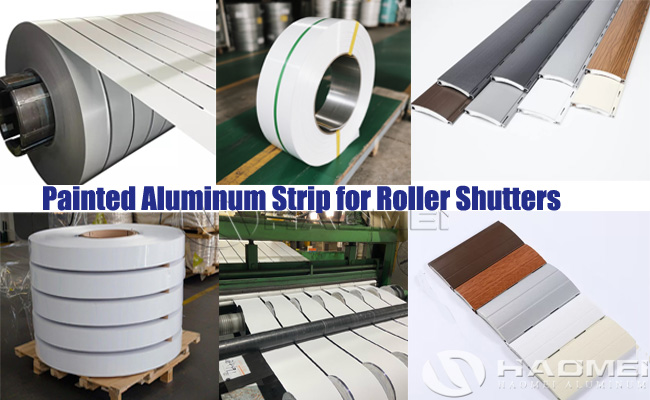
Painted aluminum strips for roller shutters are pre-coated aluminum materials used to manufacture slats for roll-formed roller shutter doors, windows, garage doors and architectural shading systems. This material undergoes a continuous coil-coating process—including surface cleaning, chemical pretreatment, the application of primer and topcoats, and thermal curing—before being slit into narrow strips to meet the requirements of roll-forming equipment. Through subsequent processes such as roll-forming, ribbing, bending, and interlocking, these painted aluminum strips are shaped into roller shutter slats with various cross-sectional profiles and colors. Compared to post-forming painting, the use of prepainted aluminum strips is better suited for continuous, high-volume production and ensures greater consistency in color and coating quality across different batches.
Why Choose Painted Aluminum Strips for Roller Shutter Slats?
With a density of approximately 2.70 g/cm³, aluminum helps reduce the overall weight of roller shutter systems, thereby easing the load on drive motors, guide rails and winding shafts. For residential window shutters, commercial storefront shutters, and garage doors, lighter-weight aluminum slats facilitate smoother operation and ensure long-term durability.
Aluminum substrates possess inherent resistance to atmospheric corrosion; when combined with a pre-applied paint coating, this resistance is further enhanced against rain, UV radiation, dust, and everyday pollutants. Furthermore, these coatings are available in a wide range of finishes—including white, gray, beige, brown, black, and wood-grain patterns, as well as various RAL color options—to meet the aesthetic requirements of building facades and door/window systems.
Common Base Alloys and Tempers
For aluminum strips for roller shutters, Al-Mn series alloys—such as 3003, 3105, and 3004—are typically employed. These materials offer excellent roll-formability, corrosion resistance, and strength, making them well-suited for processes such as profile roll-forming, interlocking bend fabrication, and stiffening-rib embossing.
For shutter slats requiring higher strength, greater dent resistance, or specialized corrosion resistance, 5052 aluminum alloy may also be considered. However, when using 5052 aluminum strips, factors such as forming radius, spring-back, and coating performance during bending must be carefully evaluated against the specific slat cross-section and the manufacturing equipment/process.
Commonly used tempers include H24, H26, H44, and H46. The final selection requires a balance between slat rigidity, roll-formability, and the coating’s resistance to cracking at bend points. Mechanical properties—which vary by alloy, thickness, and temper—should be verified against the material test certificate and relevant technical specifications.
Coating Systems and Surface Finishes
Outdoor roller shutters typically utilize PE (polyester), SMP (silicone-modified polyester), or PVDF coatings. PE coatings are suitable for general environments and standard architectural applications; SMP offers superior weatherability and resistance to chalking; while PVDF is frequently specified for exterior applications or coastal projects that demand exceptional long-term weather resistance, color retention, and UV protection.
Parameters such as coating thickness, gloss level, color, hardness, adhesion, T-bend performance, and solvent resistance should be determined based on specific project requirements. Given that roller shutter slats undergo multiple stages of roll-forming and bending, it is advisable to conduct forming trials prior to mass production to check for issues such as whitening, micro-cracking, or coating delamination at the bend points.
Surface finish options include high-gloss, semi-gloss, matte, textured (sandy), embossed, or wood-grain patterns, as well as the application of a protective film. Wood-grain and other specialized textures typically require additional printing or lamination processes; the weatherability of these finishes should be evaluated based on the final, completed surface system.
Common Specifications
Painted aluminum strips for roller shutters typically have a thickness ranging from 0.30 mm to 1.20 mm, with 0.40 mm, 0.50 mm, 0.60 mm, 0.70 mm, 0.80 mm, and 1.00 mm being the most common. The width can be customized via slitting based on the unfolded width of the shutter slats and the requirements of the roll-forming machine; typical widths for these slit strips range from 40 mm to 300 mm.
Standard inner diameters for coils are 300 mm, 400 mm, or 508 mm, though these can also be customized to meet specific equipment requirements. Other parameters—such as coil weight, outer diameter, edge quality, camber (curvature), burr direction, and the allowable number of joints—should also be verified to ensure they do not interfere with continuous roll-forming production.
When sourcing painted aluminum strips for roller shutters, it is advisable to specify the base alloy, temper, thickness, width, color standard, gloss level, coating system, coating film thickness, protective film, and processing method. Haomei Aluminum offers painted aluminum strips—available in alloys 3003, 3105, 3004, and 5052—specifically designed for roller shutter roll-forming. We provide customization options for color, thickness, slitting, coating systems, and protective films, as well as moisture-proof packaging suitable for export.


Related News
- Painted Aluminum Strip for Roller Shutters
- 5052 VS 5154 Aluminum Strip For Cable Armouring
- Aluminum Strip for Heat Exchanger Fins With Blue Coating
- Cable Wrapping Aluminum Foil
- 5154A H22 Aluminum Strip For Cable Armoring
- Transformer Aluminum Strip Price Per Ton
- 3003 H19 Aluminum Strip For Insulating Glass Spacer Bar
- What Is Aluminum Strip With Round Edges?
- Burr Free Aluminium Strip For Transformer Winding
- 1060 Aluminum Strip for Electric Cable Armouring
