
Cable Wrapping Aluminum Foil
In the cable manufacturing process, wrapping is the core step in shielding layer formation. Aluminum foil, as the most widely used wrapping shielding material, directly determines shielding effectiveness and production line efficiency through its material properties and processing precision. As a fundamental component of cable shielding systems, cable wrapping aluminum foil is not ordinary thin aluminum coils, but a high-purity aluminum processed material customized for longitudinal wrapping and other wrapping processes. It adheres to stringent industry standards in terms of flexibility, dimensional accuracy, and surface quality.
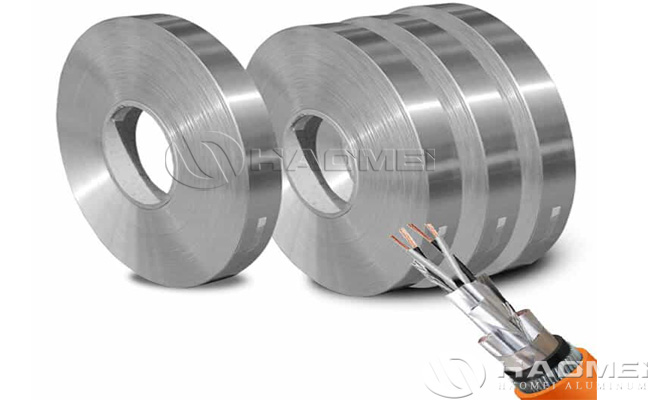
Cable wrapping aluminum foil primarily uses 1060 and 1100 series high-purity aluminum as the base material, with an aluminum content ≥99.60%, and is standardly configured in the O fully annealed temper to ensure ultimate ductility and bending performance. Standard supply thicknesses range from 0.03mm to 0.15mm, with 0.03-0.06mm thin aluminum foil suitable for high-speed spiral winding processes, and 0.08-0.15mm thick aluminum foil suitable for longitudinal wrapping and armored inner lining winding. In terms of core performance, the O temper aluminum foil has an elongation of ≥25%, capable of withstanding continuous bending at multiple stations without cracking; its conductivity is ≥62% IACS, effectively shielding against power frequency and radio frequency electromagnetic interference, with a shielding attenuation value of 30-60dB, meeting the shielding level requirements of most communication cables, control cables, and radio frequency cables.
For high-speed winding production lines, the dimensional accuracy and edge quality of the aluminum foil are key factors determining production efficiency. Under industry standards, thickness tolerance must be controlled within ±0.002mm, slitting width deviation ≤±0.1mm, edge burr height ≤0.01mm, and the roll end face must be neat without towering or misalignment to avoid downtime due to deviation or strip breakage during high-speed operation. Meanwhile, pinhole control is crucial for shielding reliability: aluminum foil with a thickness of 0.05mm or more should be free of visible pinholes, with ≤5 micropores per square meter to avoid shielding blind spots after winding. This is a common pitfall for many cable manufacturers—low-priced aluminum foil often results in substandard cable shielding performance due to excessive pinholes, ultimately leading to rework of the entire batch and higher overall costs.
Haomei Aluminum, as a professional cable aluminum strip foil supplier, ensures that its cable winding aluminum foil complies with ASTM B479 standards throughout the entire process. An online pinhole detection system is used to inspect each roll, ensuring that pinhole control of the finished product is superior to the industry average. High-precision slitting equipment allows for customization of widths as small as 15mm, and the maximum single roll length can reach 6000 meters, significantly reducing the number of downtimes during production. We can also adjust the hardness and shape of the aluminum foil according to the specific parameters of the customer's winding equipment to adapt to high-speed winding machines of different brands.
Overall, cable wrapping aluminum foil is a typical "small material, high precision" product. Its value lies not only in its shielding function but also in its support for cable production efficiency and finished product qualification rate, making it an indispensable core supporting material in cable manufacturing.


Related News
- Cable Wrapping Aluminum Foil
- 5154A H22 Aluminum Strip For Cable Armoring
- Transformer Aluminum Strip Price Per Ton
- 3003 H19 Aluminum Strip For Insulating Glass Spacer Bar
- What Is Aluminum Strip With Round Edges?
- Burr Free Aluminium Strip For Transformer Winding
- 1060 Aluminum Strip for Electric Cable Armouring
- Aluminum Fin Stock Strip For Heat Exchanger
- Haomei Aluminum Strip Coil for External Blinds
- High Conductivity Aluminum Strips
